Saturday, April 27, 2024
The further adventures of Comet 12P-Pons_Brooks 27 April-27 May, 2024.
 |  |
| Printable Black and White chart for locating Comet 12P 27April-27 May. Click to embiggen and print. Use with a red light torch (or a standard torch with red cellophane over it) to preserve your night vision. | Printable Black and White Binocular chart for locating Comet 12P from 27 Aril to 6 May. The circle represents the approximate field of view of 10x50 binoculars. The comet is within binocular range of nu Taurii until around 2 May. Click to embiggen and print. Use with a red light torch (or a standard torch with red cellophane over it) to preserve your night vision. |
 |  |
| Photo realistic view of the evening sky simulated in Stellarium for Satday, April 27 as seen from Adelaide at 18:33 ACST (60 minutes after sunset, click to embiggen). Comet 12 P is within binocular range of nu Taurii. | Photo realistic view of the evening sky on Sunday, May 19 as seen from Adelaide at 18:45 ACST (90 minutes after sunset, click to embiggen). Comet 12P is close to the bright star Rigel in Orion (the inset is the approximate binocular view of the trio). |
Comet 12P Pons-Brooks hype continues (the "once in a life-time" comet, which is true for most comets). As the comet climbs of oth the horizon murk, it remains binocular only, but we have been getting some nice images of it with a tubby tail.
While
the comet is still reasonably bright magnitude at 4.5, it remains low to the horizon over the next week or so. While it is slowly climbing above the horizon into darker skies, it is slowly fading. You will
definitely need binoculars, unless you are in a dark sky location, and then it will look like a fuzzy dot.
From the 27th April to the 3rd May the comet will be within binocular distance of star nu Taurii. Although the comet is magnitude 4.5 - 4.6 at this time and theoretically dimly visible to the unaided eye, atmospheric extinction will mean it is more like magnitude 5. The comet will still look like a faint fuzzy dot.
At nautical twilight (and hour after sunset) on the 27th, it is almost 2 hand-spans above the horizon and the darkening twilight skies should help you spot it. At astronomical twilight (an hour and a half after sunset) it will be a hand-span above the horizon (and you will need a level, unobstructed horizon to see it.
Using an ordinary camera, try zooming in around 3x and using multiple 1 second ISO 3200 exposures, but nothing below ISO 1600. (I have also done 2 and 4 second exposures, but I have an S24, so that’s cheating). I have yet to try stacking, there may be too few stars visible to stack reliably until later in the week.
12P Pons-Brooks will climb higher and fade as it rises (not much though). From the 27th - around 2 May it is within binocular distance of nu Tau (see charts, sweep west of Aldebaran for around two binocular widths). At this time, at nautical twilight is over two hand-spans from the horizon and magnitude 4.5 and another good opportunity for imaging.
Thene there are no good guide stars until 9-12 May when it is close to nu Eridanus, when it is around magnitude 5, and then it passes by Orion, and is with binocular distance of bright Rigel from the 18th -24th. Although 12P will be approaching magnitude 6, this should be an excellent opportunity for wide field astrophotography with the comet almost 3 hand-spans from the horizon at astronomical twilight, when the sky is fully dark, near the iconic Orion constellation, with the first quarter Moon not interfering too much.
Labels: 12P, astrophotography, binocular, comet

Thursday, April 25, 2024
Occultation of Sigma Scorpii, morning, April 27, 2024
 |  |  |
| North-west morning sky on Saturday, April 27 as seen from Adelaide at 02:01 ACST. The Moon is just about to cover (occult) the bright star Sigma Scorpii. The inset shows the moon at 3:32 ACST as the moon moves off Sigma Scorpii. Click to embiggen | North-west morning sky on Saturday, April 27 as seen from Melbourne at 02:48 AEST. The Moon is just about to cover (occult) the bright star Sigma Scorpii.The inset shows the moon at 4:15 AEST as the moon moves off Sigma Scorpii. Click to embiggen | North-east evening sky on Friday, April 26 as seen from Perth at 23:49 AWST. The Moon is just about to cover (occult) the bright star Sigma Scorpii. The inset shows the moon at 1:06 AWST on the 27th as the moon moves off Sigma Scorpii. Click to embiggen |
On the morning of Saturday, April 27, the bright star Sigma Scorpii (Alniyat) in the head of the Scorpion is occulted by the Moon. Sigma Scorpii is one of the two bright stars flanking the bright red star Antares.
The occultation occurs with the Moon high above the north-western horizon at the start for the eastern and central states. Perth sees the occultation start just before midnight above the north eastern horizon. Darwin misses out although Sigma Scorpii will be seen very near to the Moon. Disappearance and appearance times are given in the table below. Other locations will see the occultation at a similar time for cities at a similar latitude.
While the occultation is visible to the unaided eye, the sight will be better in binoculars or a small telescope. Set up ahead of time so that you can be sure everything is working well and you can watch the entire event comfortably. Sigma Scorpii will be clearly visible to the unaided eye near the Moon.
To the east, Saturn will rise while the occultation is ongoing, followed by Mars. Around dawn the lineup Of Saturn, Mars and Mercury will be seen.
| Place | Disappears Bright Limb | Reappears Dark Limb | Astronomical Twilight |
| Adelaide ACST | 02:01 | 03:32 | 05:23 |
| Brisbane AEST | 03:12 | 04:27 | 04:52 |
| Canberra AEST | 02:55 | 04:24 | 05:11 |
| Darwin ACST | - | - | 05:41 |
| Hobart AEST | 02:58 | 04:15 | 04:51 |
| Melbourne AEST | 02:48 | 04:15 | 05:29 |
| Perth AWST | 23:49 (26th) | 01:06 | 05:23 |
| Sydney AEST | 03:01 | 04:28 | 05:03 |
Labels: binocular, Moon, Occultation, star, unaided eye
Wednesday, April 24, 2024
Thursday April 25 to Thursday May 2
The Last Quarter Moon is Wednesday, May 1. Jupiter is lost in the western twilight sky. Comet 12P Pons-Brooks is visible in binoculars and will progressively climb higher over the week. In the morning Mars and Saturn are high in the morning sky with Mercury and Venus below. Venus is barely visible low in the morning twilight below the line up. Occultation of sigma Scorpii in the morning of the 27th.
The Last Quarter Moon is Wednesday, May 1.

While the comet is a
reasonable bright magnitude 4.5, it is still not far from the horizon. You will definitely need binoculars. Over the week the comet will climb higher above the horizon and into darker skies, but becomes dimmer as it rises. Spotters charts are here.
Similar views will be seen from the rest of Australia at the equivalent local time (60 minutes after sunset).

While the comet is a reasonable bright magnitude 4.5, it is still not far from the horizon. You will definitely need binoculars. Over the week the comet will climb higher into darker skies and. Spotters charts are here.
Similar views will be seen from the rest of Australia at the equivalent local time (60 minutes after sunset).


Elsewhere in Australia will see a similar view at the equivalent time (90 minutes after sunset).
Mercury climbs higher into the twilight.
Venus is very low in the morning twilight, and is difficult to see.
Mars is rising in the morning twilight.
Jupiter is lost in the twilight sky.
Saturn climbs higher in the morning twilight.
Star Map via Virtual sky. Use your mouse to scroll around and press 8 when your pointer is in the map to set to the current time.
Cloud cover predictions can be found at SkippySky.
Here is the near-real time satellite view of the clouds (day and night) http://satview.bom.gov.au/
Labels: weekly sky
Wednesday, April 17, 2024
Thursday April 18 to Thursday April 25
The First Quarter Moon is Tuesday, April 16. Jupiter is very low in the north-western twilight sky. Comet 12P Pons-Brooks may be visible above Jupiter at the beginning of the week and will progressively climb higher over the week. In the morning Mars and Saturn are high.Venus is barely visible low in the morning twilight below the pair. Mercury joins Venus late in the week and is closest on the 20th.
The First Quarter Moon is Tuesday, April 16. The Moon is at apogee, when it is furthest from the Earth, on the 20th.

While the comet is a
reasonable bright magnitude 4, it is still not far from the horizon and
will be difficult to see it through the horizon murk. You will definitely need binoculars. Over the week the comet will climb higher above the horizon murk and should be easily located in binoculars by sweeping up from Jupiter. Spotters charts are here.
Similar views will be seen from the rest of Australia at the equivalent local time (60 minutes after sunset).


Elsewhere in Australia will see a similar view at the equivalent time (90 minutes after sunset).
Mercury emerges into the twilight and is close to Venus on the 20th.
Venus is very low in the morning twilight, it is sinking towards the horizon and will be lost in the twilight by the end of the Month. Mars and Saturn draw away from Venus. Mercury is close to Venus on the 20th.
Mars is rising in the morning twilight and moving away from Venus.
Jupiter is visible very low in the early evening twilight sky.
Saturn climbs higher in the morning twilight. Saturn draws away from Mars rising higher in the morning sly.
Star Map via Virtual sky. Use your mouse to scroll around and press 8 when your pointer is in the map to set to the current time.
Cloud cover predictions can be found at SkippySky.
Here is the near-real time satellite view of the clouds (day and night) http://satview.bom.gov.au/
Labels: weekly sky
Saturday, April 13, 2024
Imaging 12P-Pons_Brooks challenge 14-30 April, 2024.
 |  |
| Printable Black and White chart for locating Comet 12P 10April-10 May. Click to embiggen and print. Use with a red light torch (or a standard torch with red cellophane over it) to preserve your night vision. | Printable Black and White Binocular chart for locating Comet 12P. The circle represents the approximate field of view of 10x50 binoculars.Click to embiggen and print. Use with a red light torch (or a standard torch with red cellophane over it) to preserve your night vision. |
 |  |
| Photo realistic view of the evening sky simulated in Stellarium for Sunday, April 14 as seen from Adelaide at 18:48 ACST (60 minutes after sunset, click to embiggen). Jupiter is very low above the north-western horizon and within binocular distance of Uranus and the comet 12P (the inset is the approximate binocular view of the trio). | Photo realistic view of the evening sky on Sunday, April 21 as seen from Adelaide at 18:39 ACST (60 minutes after sunset, click to embiggen). Jupiter is almost lost above the north-western horizon. Comet 12P is close to the pair of Xi and omicron Tau (the inset is the approximate binocular view of the trio). |
Comet 12P Pons-Brooks has been subject to a little bit of hype ("the Devil Comet" because at one stage its U shaped Coma could be interpreted, if you squinted hard, as devils horns), but it is truly a beautiful little comet. While we have seen some gorgeous images coming from the northern hemisphere, most of them require serious kit. Nonetheless even simple camera/mobile phone may get some nice images.
While
the comet is a
reasonably bright magnitude 4.5, about as bright as the star Taygeta (19 Tau) in the Pleiades, it is so low to the horizon that you
will be difficult to see it through the horizon murk over the next week or so. You will
definitely need binoculars, even if you can see the brighter stars of the nearby Pleiades clearly. While the comet is much brighter than Vesta in the Vesta challenge, it is lower in the horizon murk and a more extended object, making it more of a challenge.
On the 14th the comet will be within binocular distance of Jupiter. Although the comet is magnitude 4.5 at this time and theoretically dimly visible to the unaided eye, atmospheric extinction will mean it is more like magnitude 6. The comet will look like a faint fuzzy dot.
At nautical twilight (an hour after sunset) it will be around three finger-widths above the horizon (and you will need a level, unobstructed horizon to see it). You may have better success looking a bit earlier, when it will be higher despite the brighter twilight sky. Terry Lovejoy was successful in capturing the comet with 7x 1 second exposures at 100 ASA using a Sony A7iii.
Using a more ordinary camera, try zooming in around 3x and using mutiple1 second 100 ISO imaging (you WILL need a tripod for this). Higher ISO (ASA) values will make the sky brighter as well as the comet, so will not be as effective. You may wish to play around with the settings if you have time before the comet sets.
UPDATE: forget everything I said about imaging. I have been able to get it with 1 second ISO 3200 and 3x zoom, but nothing below ISO 1600. (I have also done 2 and 4 second exposures, but I have an S24, so that’s cheating). I have yet to try stacking, there may be too few stars visible to stack reliably.
12P Pons-Brooks will climb higher and brighten as it rises (not much though). It should be more or less easily located in binoculars by sweeping up from Jupiter (see printable charts and maps above).
On the 21st the comet will be at it's brightest (unless it undergoes another outburst, it has had nights where it was substantially brighter) at magnitude 4.4 (although atmospheric extinction means it is more like magnitude 5.3 at astronomical twilight, an hour after sunset). At this time it will be nearly two hand-spans above the horizon, almost on top of the two stars Xi and omicron Tau (both around magnitude 3 and readily visible, see charts above). If you can't readily see the pair locate the rather obvious Aldebaran (and the Hyades) and sweep down an to the west by about three binocular widths and the pair should be obvious.
Again, you may wish to look earlier when the comet is higher, and the twilight brighter. While the comet will still look like a fuzzy dot in binoculars, you may be able to see a short tail.
For imaging try zooming in so the pair of Xi and omicron Tau take up a decent proportion of the field of view (not too much as the resolution of most point and click cameras and mobile phones degrade severely on zoom) and take multiple 1 second images (I use between 10-20 images), you may try higher ISOs to try and capture more comet detail. Stack the images with an appropriate stacking software. Free Stacking software includes Deep Sky Stacker and Autostakkert for Windows, and StarStaX for macOS.
After this 12P Pons-Brooks begins to fade, but still remains "bright", sweeping your binoculars up from Xi and omicron Tau should pick it up. on the 29th it is within binocular distance of nu Tau (see charts, sweep west of Aldebaran for around two binocular widths). At this time, at nautical twilight is over two hand-spans from the horizon and magnitude 4.5 and another good opportunity for imaging.
Labels: 12P, Astrophiz, astrophotography, comet
Tuesday, April 09, 2024
Thursday April 11 to Thursday April 18
The First Quarter Moon is Tuesday, April 16. Jupiter is very low in the north-western twilight sky and is near the crescent Moon on the 11th. Comet 12P Pons-Brooks may be visible near Jupiter on the 14 and willl progressively climb higher over the week. In the morning Mars and Saturn spectacularly close on the 11th.Venus is barely visible low in the morning twilight below the pair.
The First Quarter Moon is Tuesday, April 16.

Evening sky on Thursday, April 11 as seen from Adelaide at 18:51 ACST (60 minutes after sunset, click to embiggen). Jupiter is low above the north-western horizon and within binocular distance of Uranus. Jupiter will also be not far from the thin crescent Moon and the comet 12P.
While the comet is a reasonable bright magnitude 4, it is so low to the horizon that you will be unlikely to see it through the horizon murk. You will have to wait for next week for the chance of a decent view.
Similar views will be seen from the rest of Australia at the equivalent local time (60 minutes after sunset).

While the comet is a
reasonable bright magnitude 4, it is so low to the horizon that you
will be difficult to see it through the horizon murk. You will definitely need binoculars. Over the week the comet will climb higher above the horizon murk and should be early located in binoculars by sweeping up from Jupiter.
Similar views will be seen from the rest of Australia at the equivalent local time (60 minutes after sunset).
Similar views will be seen from the rest of Australia at the equivalent local time.


Elsewhere in Australia will see a similar view at the equivalent time (90 minutes after sunset).
Mercury is lost in the twilight.
Venus is very low in the morning twilight, it is sinking towards the horizon and will be lost in the twilight by the end of the Month. Mars and Saturn draw away from Venus.
Mars is rising in the morning twilight and moving away from Venus. Mars and Saturn come closer to each other being closest on the 11th.
Jupiter is visible very low in the early evening twilight sky. It is coming closer to Uranus and is within binocular distance of Uranus. On the 14th it will be close to comet 12P Pons-Brooks.
Saturn climbs higher in the morning twilight. Mars and Saturn are closest on the 11th. Then Saturn draws away from Mars.
Star Map via Virtual sky. Use your mouse to scroll around and press 8 when your pointer is in the map to set to the current time.
Cloud cover predictions can be found at SkippySky.
Here is the near-real time satellite view of the clouds (day and night) http://satview.bom.gov.au/
Labels: weekly sky
Sunday, April 07, 2024
Live streams of the 2024 Total Solar Eclipse (8 April UT).
 |  |
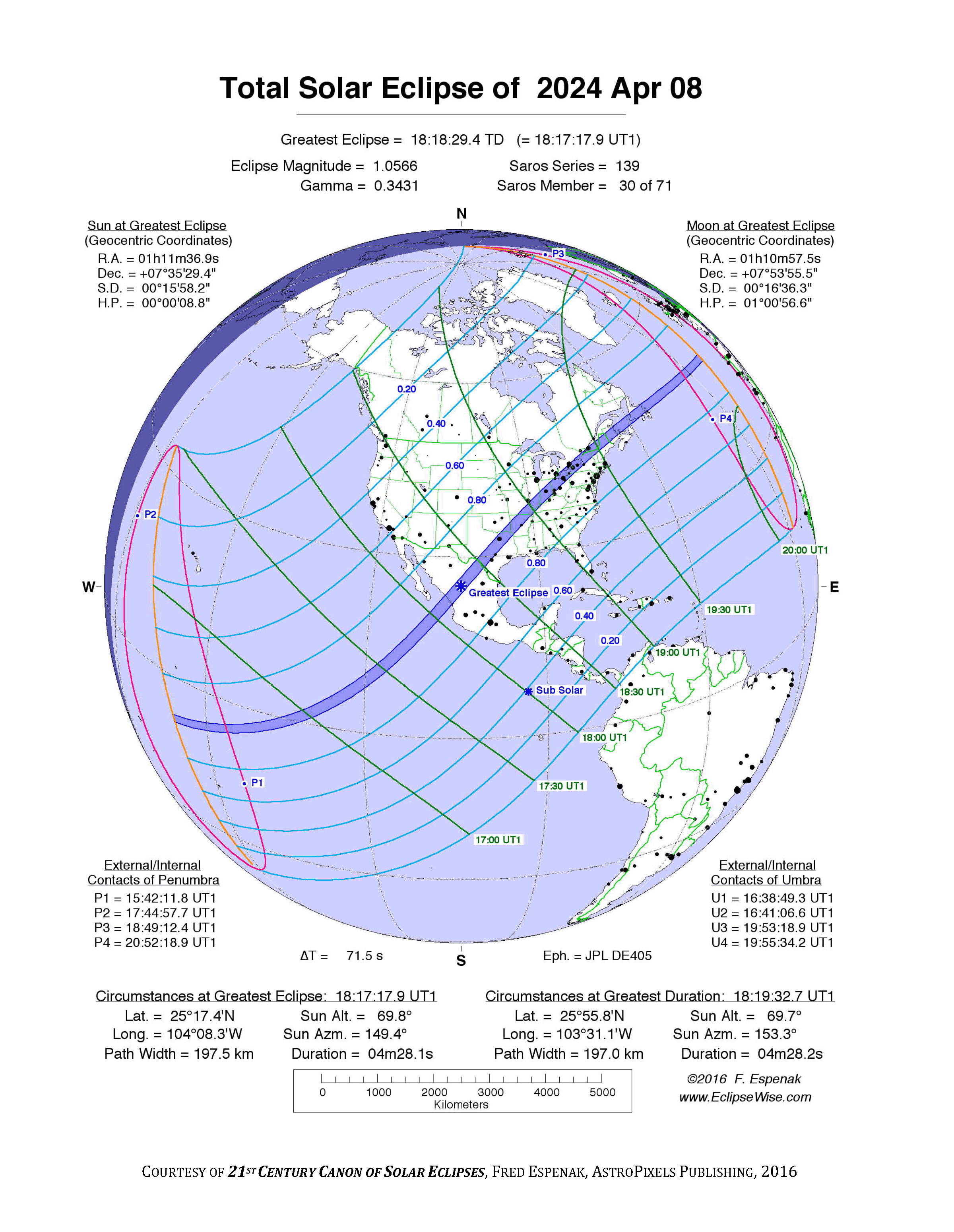
| Total Solar Eclipse as seen from Dallas, Texas on 8 April (US time 9April in Australia). Simulated in Stellarium. | Chart of the path of the solar eclipse from Fred Espenak's eclipse site |
Sadly, none of the 2024 total solar eclipse is visible from Australia. However, there are several live streams of the event we Southern Hemispherians can log into. Again, sadly, the eclipse is starting at 16:38 UT on the 8th, and is greatest at 18:17 UT. This translates to around 2 am and 4 am on the 9th (Tuesday) in Eastern Australia, so you have to be up very, very early. If you are a diehard eclipse fan, here are some live streams for you (many may be oversubscribed or choked for band width, so you may have to hop around to find one that works).
Time and date: Live-stream starts 2 am AEST on the 9th. https://www.timeanddate.com/live/eclipse-solar-2024-april-8
Virtual Telescope Project: Live-stream starts around 3 am AEST on the 9th. https://www.virtualtelescope.eu/webtv/
NASA TV. Live-stream starts around 3 am AEST on the 9th. https://science.nasa.gov/eclipses/future-eclipses/eclipse-2024/live/
Exploratorium. https://www.exploratorium.edu/eclipse
Space.com. Live-stream stars around 3 am AEST on the 9th. https://www.space.com/watch-total-solar-eclipse-april-8-online-free-livestreams
Labels: eclipse, live-stream, solar eclipse, webcast




 Click to read about or order
 Click to read about or order
 Click to read about or order
 Click to read about or order